Why Italy, Why Now
We've driven Maverick through some gorgeous stretches of California, Nevada, Oregon, and Utah. The van has been our home on wheels for weekend trips and week-long hauls up and down the coast. But last fall, sitting in our backyard in Arroyo Grande with a glass of wine, Ernie looked over at me and said, "We keep talking about Italy. What are we waiting for?" And honestly? I didn't have a good answer.
There's a version of ourselves that would have done Italy at 28 — backpacks, hostels, a Eurail pass. That trip sounds exhausting to us now, and not in a bad way. We got to do Italy our way. Hotels with real beds. Long dinners. Sitting at a café for 45 minutes watching the world go by without feeling guilty about not moving on to the next thing. Italy at this stage of life — when you've stopped trying to cram everything in and started actually savoring — is a completely different trip. A better one, if you ask us.
We did ten days: four in Florence, five in Rome, and one deliberately unscheduled day in between that turned into a slow train ride through the Tuscan countryside with no agenda whatsoever. Here's the real, unfiltered version of what it was like.
"Italy at 50 isn't about seeing everything. It's about tasting everything — and sitting down long enough to actually enjoy it."
Florence: The Arno, the Art, and the Great Uffizi vs. Accademia Debate
We stayed in a small apartment near Santa Croce — the neighborhood where Michelangelo and Machiavelli are buried and where tourists thin out just enough that you can walk a block and find a table at a place with a handwritten menu. If you're debating between staying near the Duomo or further into the Oltrarno: go further. The area around the big sights is beautiful for photos and maddening for living. The Santa Croce neighborhood gives you actual morning quiet.
We walked to the Arno every single evening around 6pm. This is non-negotiable. The light on the Ponte Vecchio and the buildings lining the water at that hour is the kind of thing you've seen in a thousand travel magazine photos and then you get there and realize the photos didn't do it justice. Ernie, who has the emotional range of a golden retriever and will freely admit it, got quiet for a solid five minutes. That tells you everything.
Now — the museum debate. The Uffizi gets all the press, and it deserves it: Botticelli's Birth of Venus, Leonardo, Raphael, room after jaw-dropping room. But our unexpected favorite was the Accademia, specifically for Michelangelo's David. You cannot understand that sculpture from photos. You have to stand at the end of that gallery and watch it come into view as you walk toward it. Buy timed entry tickets in advance for both. The Uffizi especially will have lines that will ruin your afternoon if you show up unbooked.
Tourist traps in Florence: the restaurants right on the Piazza della Signoria (overpriced, targeting people who don't know better), any gelato place with a mountain of neon-colored fluff piled high in the window (that's food coloring and air, not actual gelato), and the leather market stalls near San Lorenzo where the "handmade" bags come off the same truck. None of this is a reason not to love Florence. It's just a reason to walk one block off the obvious path.
The Food Reality: Gelato, Dinner at 8pm, and That Meal in Trastevere
Let's be honest about gelato first: we had it multiple times a day. Not as a treat. As a strategy. It's legitimately hot in Italy in June, the gelato is extraordinary, and a cone from a proper gelateria costs about the same as a bottle of water from a tourist shop. Find the places where the gelato is stored in covered metal containers (not piled in open mounds), and order the small size because the small size is still a lot of gelato. Our favorites: pistachio everywhere in Florence, and a lemon sorbetto in Rome that was so aggressively good we went back to the same shop two days later.
Dinner at 8pm was the hardest adjustment. We're Central Coast Californians — we eat at 6:30, maybe 7 if we're feeling festive. In Italy, restaurants often don't open for dinner until 7:30 or 8, and if you show up at 7, you're eating alone next to the salt shakers while the staff eyes you with gentle pity. By day three we had adjusted, and honestly we came home having completely broken our early-dinner habit. Ernie is now a firm advocate for the 8pm dinner. It changes your whole afternoon.
"The best meal of our entire trip was in a place we almost didn't go into — a tiny room in Trastevere with eight tables and a menu that changed daily based on what was at the market that morning."
That Trastevere dinner deserves its own paragraph. We'd wandered into the neighborhood — Rome's most charming, cobblestoned, vine-draped quarter on the west bank of the Tiber — and ducked into a narrow trattoria with no English menu and about eight tables. We pointed, we smiled, we used Google Translate exactly twice. What came out: cacio e pepe that tasted like it had been making itself for centuries, a grilled branzino that I still think about, a carafe of house wine that cost four euros, and a dessert nobody ordered that the owner brought over anyway because he seemed to think we looked like people who needed a little more. We did not correct him. Total bill: 42 euros for two. That's the Italy that exists if you get out of the obvious tourist zones.
Our full Italy travel vlog — Florence, Rome, and the moments we almost didn't film.
Rome: Big, Overwhelming, and Completely Worth It
Rome is a lot. More than Florence, more than almost anywhere we've been. It's a city that has been continuously inhabited for over 2,700 years and absolutely feels like it — layers on layers on layers, ancient things wedged between Renaissance things wedged between people on Vespas. It's loud, it's chaotic, it runs on a logic that takes a few days to decode. We loved it by day three. Days one and two were a little rough.
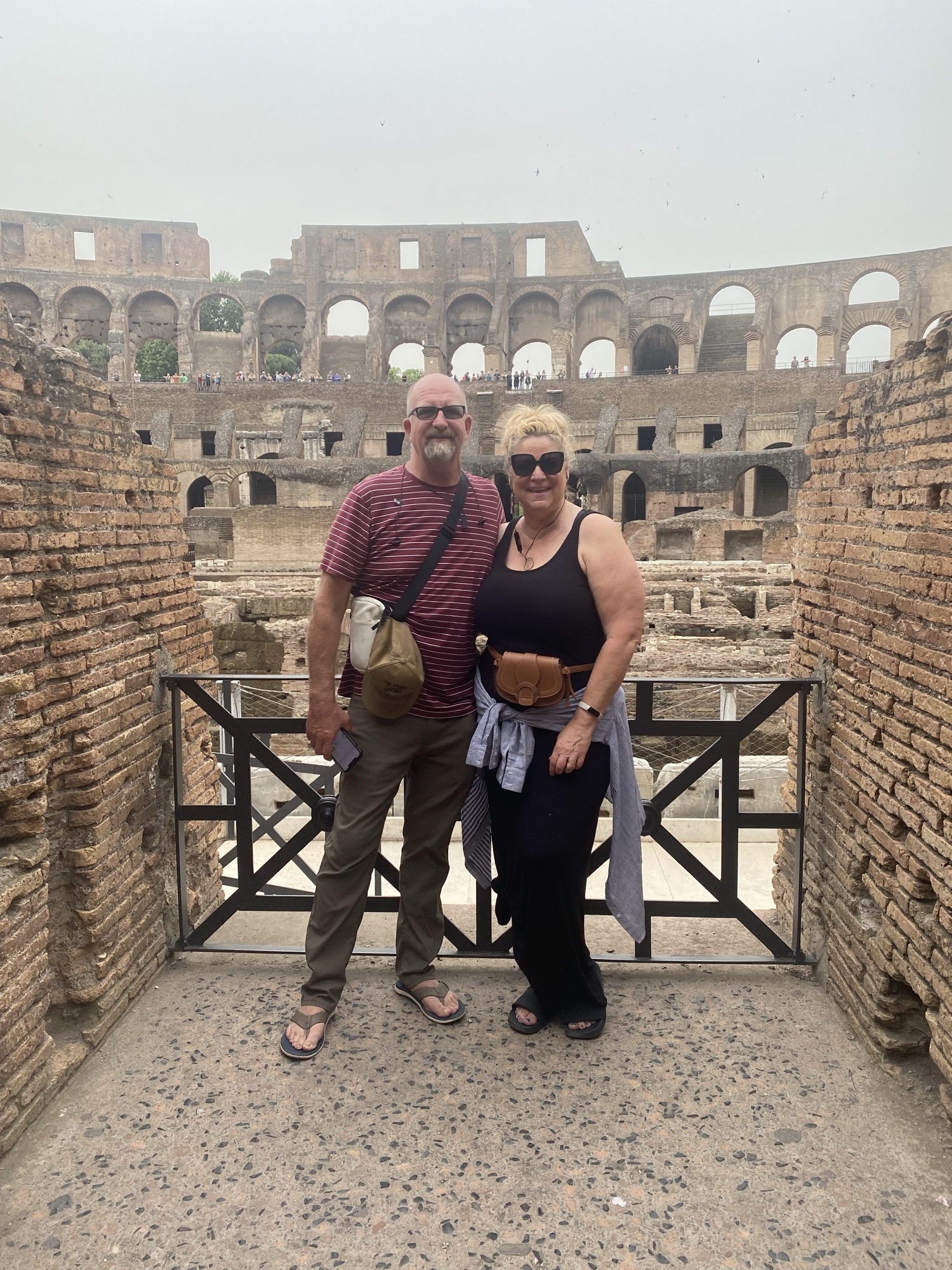
The Colosseum: go early. First ticket slot of the day, buy your timed entry online at least a week ahead. We were inside by 8:30am with manageable crowds and good morning light. By 10:30, the place was a zoo. The scale of the structure doesn't fully register until you're standing at the arena floor level looking up at those arches. Two thousand years ago, 50,000 people sat in those seats. It's one of the few tourist sights that actually delivers more than the hype.
The Vatican — and this is going to be an unpopular take — is complicated. It's one of the most visited places on earth and it shows. The Vatican Museums are genuinely astounding in terms of what they contain; the collection is staggering. But you will spend a meaningful portion of your visit being herded through corridors with thousands of other people, all of you funneling toward the Sistine Chapel, which you'll enter and spend about four minutes in before being shuffled out. Book the very first entry time, consider a small group tour that gets you in early, and go in with realistic expectations about the crowd experience. St. Peter's Basilica is free and far less chaotic — that one we'd recommend to anyone, no caveats.
Trastevere, as mentioned, is where you should spend your evenings if you spend them anywhere. It's the neighborhood Rome uses to remind you why you fell in love with Rome in the first place — winding alleys, ivy on every surface, outdoor tables lit by string lights at dusk, the smell of whatever's cooking drifting out every open doorway.
And a practical note: Rome is a walking city and there is no shortcut to this. We walked between five and nine miles a day without really trying. The upside is that you turn corners and find things — a fountain, a market, a church with a door open and something Baroque inside — that aren't in any guidebook. The downside, which we'll get to in a moment, is your feet.
What Nobody Tells You
Jet lag at 50+ hits differently than it did at 30. We knew this intellectually and were still not prepared. The nine-hour time difference from California meant our bodies were demanding lunch at 3am for the first four days. We adjusted by forcing ourselves into Italian meal and sleep timing from day one — no giving in to naps, no eating at California hours — and it worked, but it was genuinely hard for the first two days. Build transition days into your itinerary. Don't plan your most ambitious museum day for day one.
Your shoes are the most important thing you will pack. Not your camera. Not your adapter. Your shoes. We walked on cobblestones, marble staircases, uneven stone streets, and the occasional section of actual 2,000-year-old road. Ernie wore a pair of "comfortable casual" shoes on day two and had blisters by noon. Good walking shoes — ones you've already broken in at home — will save your trip. Fashion is fine. Comfort is non-negotiable.
"Tourist tired" is a real phenomenon and it sets in around day four. This isn't regular tired. It's the specific exhaustion of too many incredible things in too short a span — sensory overload from museums, decision fatigue from menus you can't fully read, the cognitive load of navigating a foreign city. We built in a half-day on day five with absolutely nothing scheduled. Sat at a café. Read. Watched people. It reset us completely.
Credit cards don't always work at smaller trattorias. Many smaller restaurants, especially the family-run ones worth seeking out, are cash only or have minimums. Always have euro in your pocket. We got caught twice having to find an ATM mid-evening, which is annoying when you've just had a wonderful dinner and all you want to do is pay and linger. Use your bank's ATM network to avoid fees, and pull out a reasonable amount when you do.
Tips for Couples: What We'd Do Differently
Book an apartment, not a hotel. This is the single piece of advice we give everyone now. We had a small apartment in each city with a kitchen we used maybe twice, but the real value was the space — a living room to decompress in at the end of the day, the ability to have coffee made exactly how we like it before the city woke up, a real table to spread maps and plans out on. Hotels are fine. Apartments are better for couples on longer trips.
We also adopted a daily food rule that served us perfectly: one splurge meal and one cheap trattoria per day. The splurge meal might be a recommended restaurant, a place we'd spotted with a beautiful terrace, or somewhere a local told us about. The cheap trattoria is the place with the handwritten specials board and the three-euro wine. Both types of meals were consistently excellent. The ratio kept us from blowing our budget while still having the experiences worth having.
And please — do not over-schedule. Every travel blog will give you a 47-item list of things to do in Florence in four days. You cannot do 47 things in four days without doing all of them badly and remembering none of them well. Pick three non-negotiables per city. Fill the rest with wandering. The wandering is the point.
"Don't over-schedule. The wandering is the point. The wrong turn is often where the best meal is hiding."
Would We Go Back? What's Next?
Absolutely, unequivocally yes. We already have a list for the return trip: the Amalfi Coast, which we didn't have time for on this go; Cinque Terre, which we glimpsed from a train window and immediately added to the must-list; Siena and the Chianti region, because Ernie has decided his life's purpose now includes finding the perfect glass of Brunello di Montalcino in the place it was made.
Italy did something to us that we weren't expecting: it made us want more international trips. We'd been so focused on domestic travel — Maverick has taken us to some genuinely extraordinary places in our own backyard — that we'd put international adventures on the back burner. Italy moved them to the front.
Up next on our international list: Portugal (Lisbon and the Alentejo wine region), Ireland (Ernie has people there), and eventually, when the time is right, Japan. The world is bigger and more welcoming than you remember from the last time you checked, and it turns out 50-something is a spectacular age to rediscover that.
If you're sitting in your backyard right now wondering what you're waiting for — you're not waiting for anything. Book the trip.